BioFibreLoop is set to produce technical textiles, made from bio-based materials and functionalised in a safe and sustainable manner. What will the final products be exactly, how might they look like? What do you have to consider when designing the end product? To answer those questions and give you insights into the perspective of a fashion designer’s view, we interviewed Madeleine Claire Müller. She is a fashion and accessories designer and head of product development at our partner FreyZein, which is a material science & innovative textile company.
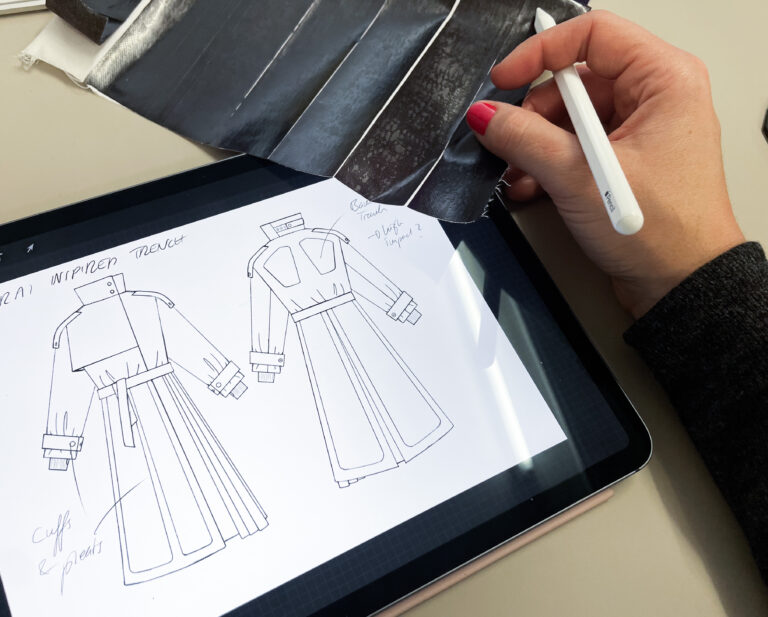
Technical design sketch by Madeleine C. Müller. ©FreyZein
Let’s start with your creative process: How do you actually design a textile?
“Every fabric is designed with its end use in mind — that’s the foundation of the creative process. A textile meant for delicate lingerie, for instance, will differ completely from one created for a rugged outdoor jacket. Once the purpose is clear, the design decisions follow naturally: Should it be made from natural or synthetic fibers? Knit or woven? What weight, hand feel, and surface structure are right? Should it be a solid color, printed, or a jacquard pattern? And what finishing or functional properties will it need?
Developing a custom fabric takes time and iteration. Depending on the complexity, the process from first concept to finished textile can take anywhere from five to eight months, so early planning is key.”
Could you walk us through the steps—from idea to finished product?
“To shape the framework of an idea, I usually start with a moodboard — a collection of images drawn from diverse references like fine art, architecture, and nature. From there, I dive into my textile sample archive to see if anything aligns with the theme I’m exploring. Vintage pieces are also a constant source of inspiration.
When it comes to sourcing, trade shows are an excellent starting point. They bring together international suppliers in one place, giving you the chance to see and touch samples firsthand and to speak directly with manufacturers about key details like minimum order quantities, lead times, custom options, and pricing. Most fairs also feature curated areas focused on innovation and upcoming trends, such as color palettes and fabric developments — these are always my first stop, as they provide a quick overview of what’s new and relevant in the industry.
If you’re developing a custom fabric, having a reliable network of suppliers is essential. Collaboration and iteration — through lab dips, printing trials, and sampling — are part of the process. And if you plan to work with specific fibers or branded yarns, it’s important to check early on whether additional documentation or licensing agreements are required.”
What motivated FreyZein to join the BioFibreLoop consortium? What aspects of the project align with your company’s values or goals?
“FreyZein was born out of a simple paradox: outdoor enthusiasts rely on plastic-based clothing to experience nature. Recognizing the need for innovation at the material level, what began as a clothing brand quickly evolved into a material science company.
Our mission is to engineer the next generation of natural performance textiles — materials that combine functionality with true sustainability. This vision aligns perfectly with the BioFibreLoop project, where, together with our partners, we explore how novel, bio-based performance materials can be applied in real-world consumer products.”
What role does sustainability play in your design decisions at FreyZein? How do you balance aesthetics, performance, and environmental impact?
“At FreyZein, sustainability isn’t an afterthought — it’s the foundation of everything we create. In fact, your question captures the essence of our research and design philosophy:
How can we deliver high performance through natural textiles, minimize environmental impact, and still offer products that meet today’s standards for scalability, functionality, and design appeal?
This balance between performance, aesthetics, and responsibility is what drives every development we undertake.”
How do you work with bio-based materials at FreyZein?
“At FreyZein, we have an ongoing research and design process centered on developing novel bio-based solutions. Our in-house laboratory allows us to continuously experiment, test new ideas, and refine existing innovations.
By integrating key challenges of today’s textile industry — such as waste reduction and climate impact — into our daily work, our team consistently pushes the boundaries of what’s possible with sustainable materials.”
Are there specific design considerations when working with bio-based materials for technical applications? For example, do you need to think differently about durability, texture, or functionality?
“Many bio-based materials have unique characteristics — from their texture and drape to their scent or hand feel. These particularities can vary widely, which makes hands-on testing essential before making any design commitments. Sampling, sewing, washing, and ideally wearing trials all help reveal how a material behaves in real use.
From a technical perspective, there’s no “one-size-fits-all” approach. Each bio-based material has its own strengths and limitations, which must be carefully evaluated in relation to the intended application.”
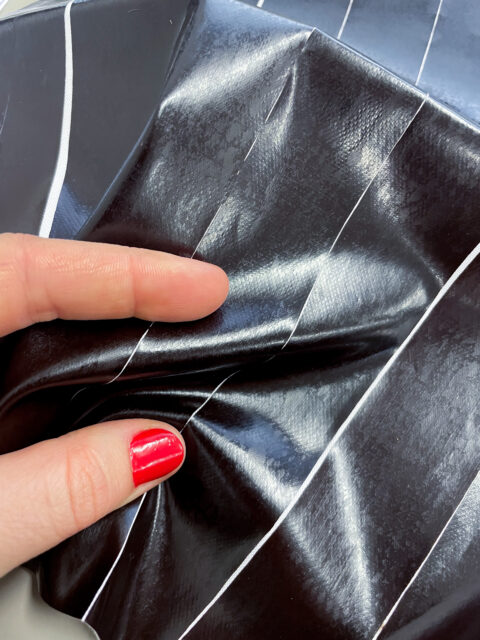
Textile sample with lignin coating created by the DITF. ©FreyZein
What challenges have you encountered in BioFibreLoop so far? And how are you and the other partners working together to overcome them?
“With so many different partners involved, communication can naturally be a challenge at times. It’s important to define responsibilities clearly and to keep an open mind, since each organization brings its own perspective and expertise.
In my experience, in-person meetings between the online sessions make a big difference — they help strengthen not only professional collaboration but also personal connections within the team.”
How do you collaborate with engineers and scientists in the project? Is there a shared language between fashion design and technical development?
“Beyond the initial ideation stage, the design process quickly becomes highly technical. Once the creative direction is set, the idea must be translated into precise technical sketches for production. From there, patterns are developed and fitted, and the cutting layout is optimized for maximum efficiency and minimal waste.
In today’s industry, production is often divided across specialized departments. While this structure allows for deep expertise and faster timelines, it can also create a gap between the concept and the final product. As more people become involved, information can get lost along the way, making it harder to maintain a cohesive design vision.
The BioFibreLoop project offers a valuable opportunity to bridge this “language barrier” between design and technical development by starting the collaboration directly at the material level. Personally, I’m a big fan of this kind of positive cross-pollination — I believe true innovation happens at the intersection of engineering, science, and design. Our shared challenge is to connect the laboratory with the real world, ensuring that what works on paper also performs for the end user.”
Let’s look ahead: What do you envision BioFibreLoop’s final products to be? What might they look like, and where could we see them used?
“While the lignin coating being developed within BioFibreLoop has many potential applications, the project’s current goal is to create an outdoor jacket for the workwear and lifestyle sectors. The coating will be strategically applied to specific areas of the garment, tailored to its intended use and performance requirements.”
What message would you like to share with the public about bio-based (technical) textiles? Why should people care about what their clothes are made of?
“The choices we make as consumers have real power — your purchasing decisions help shape the market. Supporting bio-based and sustainable textiles sends a clear signal that there is demand for these innovations. Change is a process, and no solution is perfect from day one, but demonstrating that there is a market encourages investors to back new materials, which is essential for improving and scaling them.
It’s also important to recognize that taking care of our planet is a shared responsibility. Microplastics are now being found everywhere, from the deep sea to the human placenta, and we are only beginning to understand their long-term impact on our bodies and the environment. Systemic change is urgently needed. Recycling alone isn’t enough — it has often been used as an excuse to continue producing virgin plastics that harm ecosystems. Phasing out plastics and supporting bio-based alternatives is one concrete way to make a difference.”
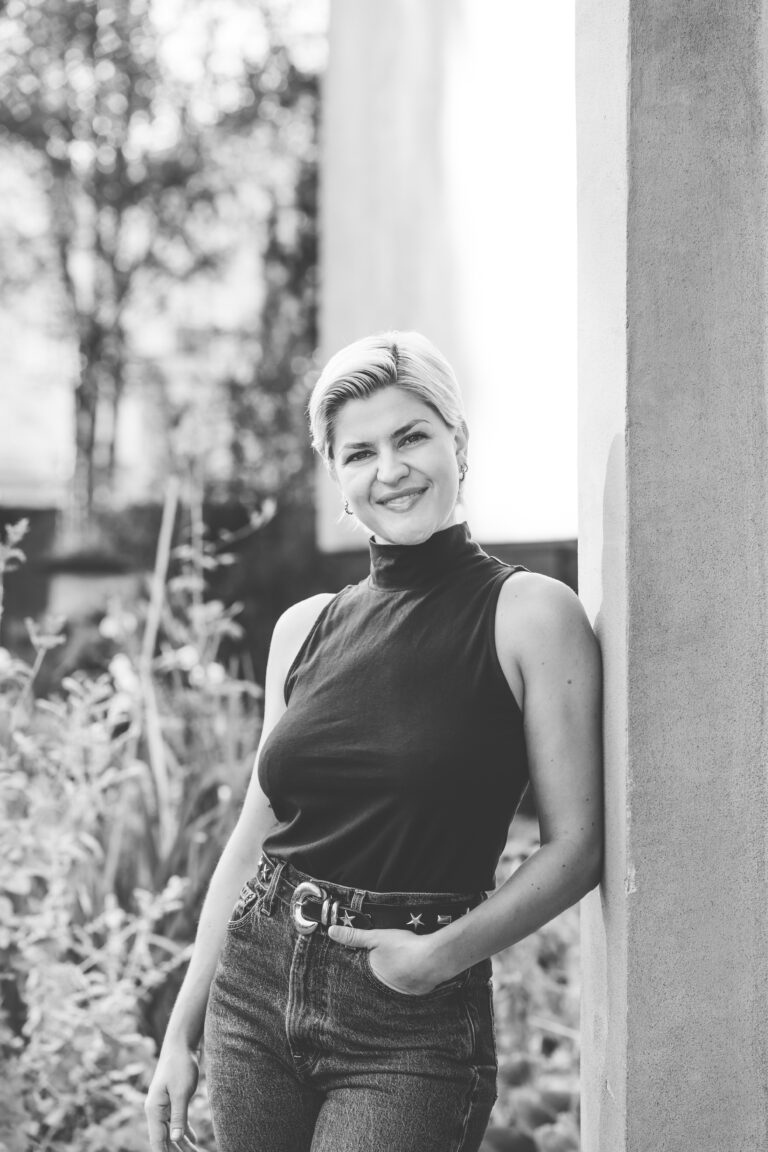
The designer Madeleine Claire Müller ©FreyZein
Who are you and what is your role in the project?
“I hold a Master’s degree in Accessories Design from Polimoda in Florence, Italy, and a Bachelor’s in Fashion Design from the Akademie für Mode und Design (AMD) in Munich, Germany. As a multidisciplinary designer, I began my career in footwear, working with international luxury houses in New York City and Paris.
The pandemic prompted me to return to Italy and focus on craftsmanship, something I’ve always deeply valued, creating bespoke handbags. Working with leather heightened my awareness of the materials used in fashion and their environmental impact. I noticed that, for many, sustainable fashion was still associated with uninspiring designs — and I wanted to change that. This led me to founding my own clothing label, offering elevated Italian streetwear that combines style and sustainability.
During my material sourcing journey, I met Dr. Enrico Cozzoni, then Innovation Team Leader and Research Director at Pangaia Materials Science Italy, who later introduced me to FreyZein. In early 2025, I moved to Austria to join FreyZein as Head of Design and Product Development. I am thrilled to be part of a team shaping change at the forefront of the textile industry, merging cutting-edge research and science with design.
At FreyZein, my work focuses on implementing innovative materials in end-consumer products. This includes designing prototypes, sourcing materials and suppliers, and managing aspects such as customer needs, manufacturing, and ensuring product-market fit.
In the BioFibreLoop project, I am responsible for designing the end-consumer product and ensuring the optimal application of the developed materials, while identifying potential challenges and finding ways to address them.
What has been/will be your personal highlight in the project?
“Probably the BioFibreLoop consortium meeting in Tampere, Finland, back in June 2025. It was my first time visiting the country and a fantastic opportunity to connect with the other project partners, exchange ideas, and experience a new culture.“
Can you share any funny or unexpected moments or learnings that you experienced while your worked on this project?
“While not entirely unexpected, the project has reinforced just how crucial it is to (re)connect the different areas of the supply chain. The stronger our mutual understanding, the better the outcome. In this context, design plays a unique role: it can bring diverse innovations together in a single product, making them more accessible and relevant to people.“
What type of BioFibreLoop clothing (active wear, outdoor wear, work wear) are you personally most excited about?
“At first, I had been hoping to include footwear in the project, but since that’s not possible, my excitement has shifted fully to the lifestyle jacket. The progress we’ve made in just a few months with the material development has been incredible, and the idea of a bio-based, oil-repellent finish is truly thrilling. I’m thrilled to translate this material innovation into a wearable jacket that’s both functional and stylish.“